
There is a specific moment in the life of a growing subreddit where someone decides to start a weekly recap thread. It goes well. Members reply, people who missed the week catch up, the regulars enjoy being named. It runs for six weeks, then eight, and then it stops, usually without an announcement, because the person writing it had a busy Monday and never picked it back up.
This is such a common pattern that it is worth treating as a design problem rather than a discipline problem. The recap is a good idea that fails for a boring reason: it takes forty minutes of manual work every single week, forever, and the person doing it is a volunteer.
Why a Recap Thread Works at All
Before automating anything, it is worth being clear about what the format actually does, because that determines what belongs in it.
A recap solves the problem that most members see almost none of your community. Someone who checks Reddit twice a week sees whatever the algorithm surfaced on those two days. They miss the excellent thread that peaked on Wednesday afternoon. A recap is the only mechanism most subreddits have for saying “here is what you missed”, and it is why the format survives despite the effort.
It also does something less obvious. Naming contributors changes behaviour. A member who gets named as the week’s top contributor is measurably more likely to post again, and the people who did not get named now know that being named is possible. This is the cheapest status mechanic available to a moderator, and it costs nothing but accuracy.
And it creates a predictable appointment. Communities with a reliable weekly rhythm give members a reason to return on a particular day, which is worth more to long-term retention than any individual post.
What Belongs in One
Having read a lot of these, the ones that work share a structure. The ones that do not work are usually just a list of links.
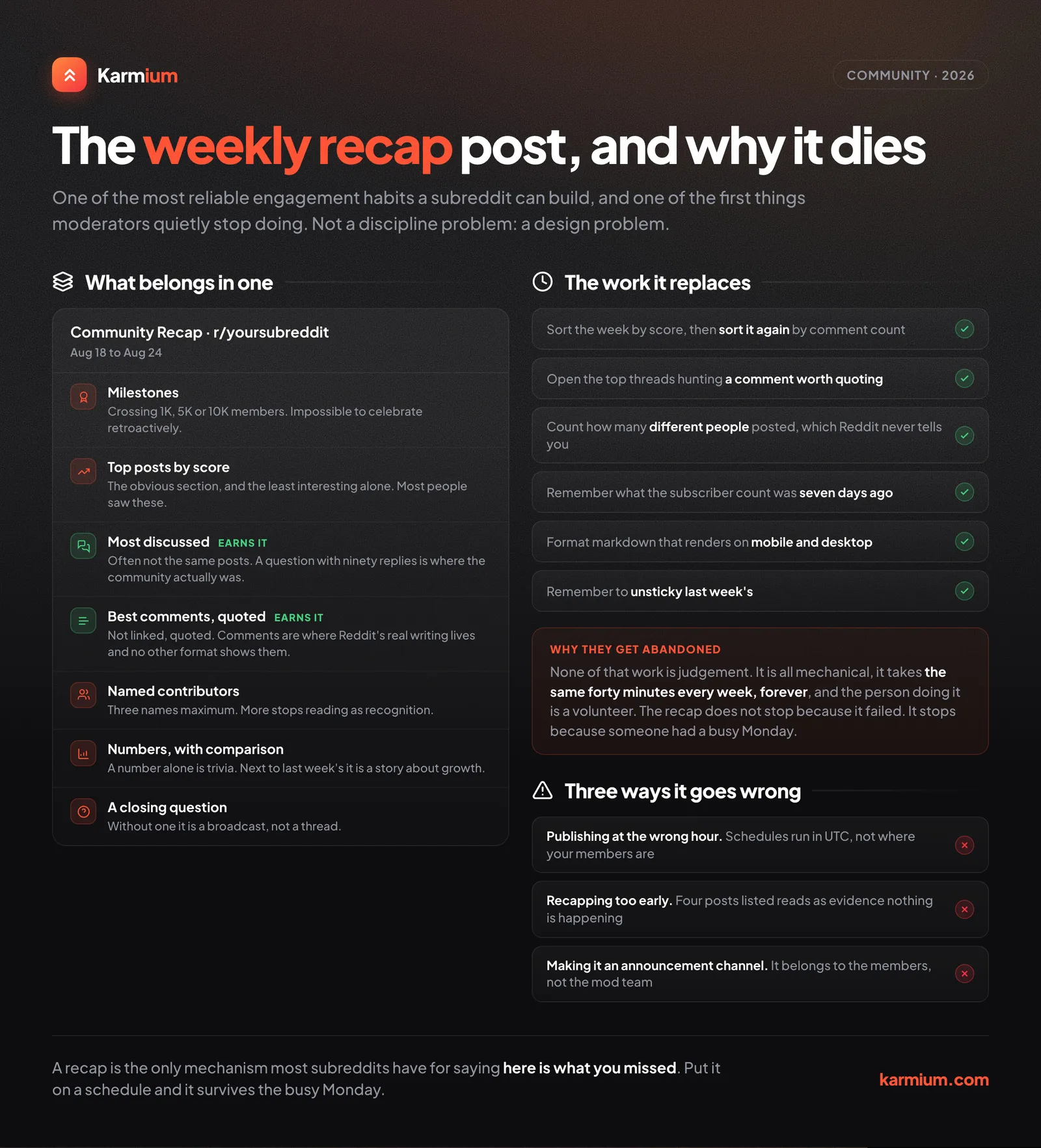
Top posts by score. The obvious section, and the least interesting on its own. It mostly tells people what they already saw.
Most discussed, separately. This is the section that earns the recap. The posts with the most comments are frequently not the highest scoring ones, and they are usually the better read: a mildly upvoted question that drew ninety replies is where the community actually was that week.
The best comments, quoted. Not linked, quoted. Comments are where Reddit’s real writing lives and they are invisible in every other summary format. Pulling a genuinely good comment out of a thread and putting it in front of everyone is the single most appreciated part of a recap.
Named contributors. Top contributor, the person whose post drew the most discussion, the author of the best comment. Three names, maximum. More than that and it stops feeling like recognition.
Numbers, with comparison. Posts, comments, active members, total members, each against the previous week. A number on its own is trivia. A number next to last week’s is a story about whether the community is growing.
Milestones. Crossing 1,000 or 10,000 members is worth marking, and it is the kind of thing that is easy to miss and impossible to celebrate retroactively.
A closing question. The recap should end by inviting a reply, or it is a broadcast. “What stood out to you this week?” is enough.
The Parts That Are Genuinely Tedious
If you have written one by hand, you know the work is not the writing. It is:
Sorting the week’s posts by score, then sorting them again by comment count, and noticing that the two lists differ. Opening the top threads to find a comment worth quoting. Working out how many people posted this week versus last week, which Reddit does not tell you anywhere. Remembering what the subscriber count was seven days ago. Formatting all of it into markdown that renders correctly on both mobile and desktop. Remembering to unsticky last week’s.
None of that is judgement. It is all mechanical, which means it is all automatable, and it is exactly why the format dies.
Putting It on a Schedule
Reddit’s developer platform can do this natively. An app installed on your subreddit can read the past seven days through the Reddit API, rank it, format it and post it on a cron schedule, running on Reddit’s own infrastructure rather than a server you maintain. No bot account, no API keys, no third-party service holding your credentials.
This is what our own app does. Community Recap publishes a weekly recap as an ordinary text post, on the day and hour you choose, with every section above available and individually switchable. A few details that matter in practice:
- It previews to your inbox. A moderator menu action builds the recap with your community’s real data and sends it to you as a private message, posting nothing. You can run it as often as you like before committing to the format, which is the part most moderators want before they let software post in their subreddit.
- Quiet weeks degrade gracefully. Sections with nothing to show are skipped, so a slow week produces a shorter recap rather than a set of empty headings, which is what makes a hand-written one look abandoned.
- It handles the sticky rotation. Each new recap is pinned and the previous one unpinned, into a highlight slot you choose, so slot one stays free for whatever your team pins by hand.
- The title is a template. Placeholders for the subreddit name, the date range and the ISO week number, or plain text if you would rather.
- Optional winner flair, off by default, because turning it on overwrites the existing user flair of the members it names, and that is not a decision an app should make for you.
It is free, it runs on Reddit, and it is installed from the App Directory like any other app: open it, click add to community, then set the day and hour in the app’s settings. If you want the wider context of what apps like this are and how the platform works, we have a plain-language explanation of Devvit, and a ranked list of the most installed moderation apps.
A Few Things That Go Wrong
Publishing at the wrong hour. Schedules run in UTC, and a recap that lands at 3am for most of your members gets buried before anyone sees it. Pick the hour against where your community actually is, not where you are.
Recapping too early. A weekly recap on a subreddit with four posts a week is a list of four posts, and it reads as evidence that nothing is happening. Wait until a normal week produces more content than a member can comfortably keep up with. That is the whole point of the format.
Treating it as an announcement channel. The recap belongs to the members, not to the mod team. The moment it starts leading with rule changes and moderator notices, engagement drops, because it stops being about them.
Naming the same person every week. If one member dominates every section, the recognition mechanic inverts and everyone else concludes the leaderboard is settled. Worth watching for, and worth varying the sections if it happens.
If You Run a Brand Community
Recaps are unusually valuable for brand subreddits, for a reason that is easy to miss: they are the one recurring post a brand can publish that is entirely about the members rather than the product. If your community is otherwise a stream of announcements, a weekly recap is the counterweight that makes the whole thing feel like a community rather than a channel.
It also produces something genuinely useful internally. A weekly, dated record of what your customers were actually discussing, in their words, is better product feedback than most surveys, and it arrives whether or not anyone remembers to look.
If you are earlier than that and still deciding whether a branded subreddit is worth running at all, start with how to build one before automating anything on top of it.
Running a community and want the recurring parts handled properly? Tell us what you are working with.